Introduction
Comfort is only one of the attributes detailed on a wheelchair cushion label. The label also describes the design features, the standards by which the cushion was tested, how to clean the cushion, and care instructions for various settings. Because the risks involved, cleaning protocols, required documentation, and lifecycle expectations differ, it is important to distinguish between hospital-grade wheelchair cushions and home-use cushions. For home caregivers and clinicians, the correct classification can impact usability, maintenance effort, budget, psychosocial issues, and the total cost of ownership, while for caregivers, it influences daily comfort.
This article examines the practical and legal distinctions found in the differences between hospital-grade and home-use cushions, the typical materials and structures, and a decision framework that integrates levels of risk, care settings, and maintenance tasks.
Hospital-Grade vs Home-Use: Key Differences
Environment and users
Hospital cushions serve inpatients, and especially those who, post-operative, immobile, or otherwise at risk for skin breakdown, require a wheelchair cushion for pressure sore prevention with some measurable pressure redistribution performance. In comparison, home-use cushions accommodate the needs of community-dwelling individuals who appreciate long periods of comfort, easy portability, and a more relaxed care routine.
Primary objectives
In home use cushions the primary objectives focus on comfort the ease of use, and value—while still providing some meaningful low- to medium-risk pressure relief. In comparison, hospital-grade products focus on clinically prioritized, hospital policy-implemented pressure relief, infection control, and safety documentation.
Documentation and oversight
Hospital use medical-grade wheelchair cushions typically include FDA registration/listing, evidence of a quality system (e.g., manufacturer ISO 13485 certification), validated instructions for hospital-compatible cleaning, and, if relevant, instructions on fire safety and material biocompatibility. In comparison, home-use cushions typically provide consumer instructions and lighter documentation.
Materials & Construction
Foam
High-resilience (HR) or viscoelastic foams span a variety of uses. Hospital-grade models may employ multi-layered, zoned, or contoured foam systems to facilitate immersion and envelopment. Performance under heavier or prolonged loads and disinfection cycles determines selection of density and thickness. Home-use foam cushions tend to be lighter, less expensive, and focused on comfort, with less emphasis on layering.
Gel
Gel inserts and gel-foam composites improve control over peak interface pressure and temperature build-up. Hospital cushions may segment or baffle gel to avoid drift, pair it with sealed covers, and disclose pressure management relevant test data. In home settings, gel enhances sitting comfort and stability but lacks institutional mandates for cleanability.
Air (adjustable)
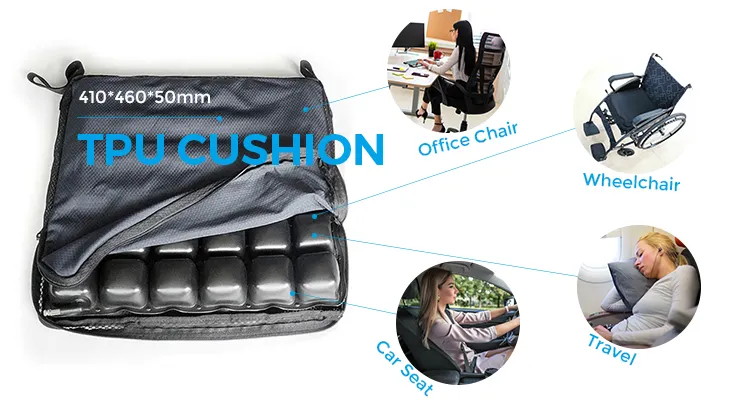
Multi-cell air cushions with adjustable immersion and pelvic stability provide excellent pressure redistribution. Hospital-grade versions typically include durable valves, repairable systems, and clinical setup guides. Home-use air cushions may emphasize weight reduction and simplified adjustment, user friendliness, and performance.
Hybrid systems
Foam, paired with either air or gel, results in hybrid designs that provide both stability and effective pressure relief. In hybrid systems configured for hospital use, designs focus on medium- to high-risk profiles and complex-seating requirements. Home-use hybrids, in contrast, prioritize pressure-relieving comforts and portability.
Covers and interfaces
Hospital covers are constructed with fluid resistant, sealed or welded seams to withstand frequent disinfection processes, hospital body fluid exposure, and wick resistance. Per fire regulations, hospital covers must include specified fire resistant materials. In contrast, home-use covers focus on breathability and comfort. Home-use covers are designed for easy removal and machine washing, include water resistant liners for washing, and sealed seams are used to provide and improve incontinence.
Safety & Compliance
Hospital-grade
-
Regulatory status: Registering with the FDA as a medical device and maintaining the establishment's registration along with device listing.
-
Quality system: ISO 13485 provisions of traceability, process control, and post-market vigilance covers the production of cushion systems.
-
Biocompatibility and materials: Medical device regulations dictate the evaluation of materials that contact skin for cytotoxicity, irritation, and sensitization.
-
Fire and infection control: Cushion systems show resistance to ignition and the cleaning chemistries of hospitals. Non-absorbent barriers with robust zippers and seams aid in disinfection and control of fluid ingress.
Home-use
-
User-friendly design: Focuses on easy assembly, lightness, and use of comfortable materials.
-
Simplified documentation: Instructions are revised to focus on home use cleaning (wipe-down and machine washable covers) and cleaning for safety.
-
When to upgrade: If risk factors increase such as pressure injury history, extreme immobility, or long periods of sitting, then clinicians will recommend switching from home use wheelchair cushions to a hospital-grade or clinical grade configuration for more aggressive pressure redistribution and increased maintainable cleanliness.
Cleaning, Maintenance & Durability
Hospital-grade cushions are designed to withstand frequent, protocol-driven cleaning using hospital-grade disinfectants with specific contact time. Materials must resist degradation, discoloration, and seam failure under chemical assault. Replaceable covers, integral liners, and other components which are serviceable and ease the cleaning cycle are designed to lengthen the cushions' life and minimize downtime.
Home-use cushions focus on routine care: covers that are removable and machine washable, and surfaces that will tolerate household wipes or mild detergents. The durability target balances comfort with cost; the replacement cycle is typically shorter and more flexible. This is driven by visible wear, loss of support, changes in user weight, risk level, and loss of support.
Pressure Management & Risk Levels
Hospital grade wheelchair cushions used in hospitals and clinic settings depend on risk stratification. In ICU, post-operation, and long-stay units, where users are considered medium to high risk, clinicians choose immersion and envelopment foam type cushions along with stable pelvic positioning such as multi-cell air or hybrid air-foam systems. For low to moderate risk home users, basic foam, gel, or hybrid cushions are appropriate and posture support is provided when users are educated on weight shifting, skin checks, and posture when seated, along with cushions.
Clinicians may consider adjustable air or hybrid cushions designed to maximize offloading stark equal to lateral stabilizing to lateral support as care for high-risk sacrococcygeal area. In contrast, active home users with moderate sitting time and intact skin may succeed with a countered foam gel design that balances comfort and ease of maintenance in offloading.
Reimbursement & HCPCS Considerations
While in clinical settings, the HCPCS codes linked to skin protection and positioning cushions are used to document prescribing, coverage, and in some instances, to determine reimbursement. In the home settings, insurance coverage hinges on medical necessity, healthcare professional documentation, and specific details in the local policy. For families, the financial a cushion, a set of spare covers, and periodic replacement schedule is essential as part of budget planning.
Comparison Table: Hospital-Grade vs Home-Use
| Dimension | Hospital-Grade | Home-Use |
|---|---|---|
| Typical users | Inpatients; high-risk or post-surgical | Community users; long-duration daily sitting |
| Materials & build | High-spec foam/gel/multi-chamber air; sealed, fluid-resistant, often flame-retardant | Comfort-focused foam/gel/lightweight hybrids |
| Compliance | FDA registration/listing; ISO 13485 QMS; infection control and fire-safety expectations | General home safety; fewer mandated tests |
| Cleaning | Compatible with hospital disinfectants; replaceable/repairable covers and liners | Wipe-clean or machine-washable covers; simple care |
| Pressure relief | Designed for medium-to-high risk management | Suited to low-to-medium risk users |
| Cost & lifespan | Higher upfront cost; prolonged service under heavy use | Budget-friendly; flexible replacement cycles |
This side-by-side view supports hospital vs home wheelchair cushion decisions by aligning features with the realities of each environment.
How to Choose
-
Risk level: Align the cushion category with the pressure injury risk (history of lesions, immobility, comorbidities).
-
Daily sitting time and posture: Lengthened and less varied sitting requires pressure redistribution systems with stronger pelvic stability.
-
Environment of care: Workflow and cleaning products used in hospitals require sealed, fluid-resistant covers. In contrast, the home environment can prioritize breathable textiles that can be laundered easily.
-
Maintenance capacity: Consider the frequency and cleaning products used by the one in charge of cleaning.
-
Budget and lifecycle: Hospitals care about the total cost of ownership (spares, repairs, cover replacements). Home users care about the initial cost, comfort, and how frequently they need to be replaced.
-
Re-evaluation: Regularly reassess fit, posture, and skin integrity. If risk increases or skin integrity declines, escalate to a hospital-grade or clinical-grade pressure relief cushion.
Senyang’s Solutions
Senyang manufactures wheelchair cushions from foam, gel, and hybrid configurations, as well as air cushions, manufacturing them from foam, gel, and hybrid configurations, as well as air cushions, all within the framework of ISO 13485’s medical-device quality system. These cushions are aimed to support medical-grade functionality in configuring both hospital and home (foam, gel, hybrid, air) options. Hospital-grade cushions maintain the additional pressures of fluid resistance, cover disinfection, and durability, and pressure redistribution for medium-high risk users. Home cushions, in addition to maintenance pressures, address ease of comfort for low risk users to ensure a wheelchair user complete home use without the risk of pressure sores. This balanced approach to functionality draws best from marketing ratios based solely on risk and maintenance required, on goals advertised by clinicians and caregivers.
Conclusion
Framing the expected use and risk, in and out of the hospital, which primarily drives the expected use for and primary risk during the clinical use of cushions, explains the difference in marketing of home and hospital-grade cushions. In the home, the primary expected use for cushions is comfort, and while pressure relief is important, it has to be meaningful at a low cost. In the hospital, the expected use is clinical control and integration with infection control. Safety policies and performance expectations must be documented. Balancing the points of expected use and risk on pressure relief provides a framework for both hospital and home use cushions. This guidance enables a strong clinical outcome.
FAQ
Q1: What makes a cushion “hospital-grade”?
Hospital grade refers to a cushion designed and documented for clinical use: FDA registered/listed as a medical device, manufactured under a quality system such as ISO 13485, compatibility with hospital grade disinfectants, and, where applicable, evidence of fire-safety and biocompatibility. Furthermore, it is not a mere marketing term; it reflects readiness for institutional use.
Q2: Are hospital-grade cushions always better for home users?
Not necessarily. Hospital-grade cushions are engineered for higher risk, heavier use, and stricter cleaning protocols which can add weight and cost. Many home users at low-to-moderate risk do quite well with a well designed foam, gel, or hybrid cushion oriented to home care, provided that skin checks and posture reviews are routine.
Q3: Do hospital-grade cushions require special cleaning protocols?
Hospital grade cushions are built to withstand hospital grade disinfectants as well as repeated wipe-downs with specific contact times. Follow manufacturer's instructions for use (IFU). Home-use models typically rely on removable, machine-washable covers and routine wiping with household products for cleaning.
Q4: Can home-use cushions be covered by Medicare or private insurance?
Coverage depends on medical necessity, documentation, and payer policy. Some cushions are covered when a clinician prescribes them for purposes of pressure management or positioning. Users should confirm requirements with the prescribing professional and the payer.
Q5: How often should each type be replaced?
For each type, the responsible reason for replacement pertains to the loss of support, damage, failure of seams, or alteration of user risk and weight. Hospital cushions service lives often extend under controlled maintenance with covers or components that are replaceable. Flexibility for replacement of home-use cushions may be comfort, wear that is visible, and changing demands.