Senyang Care

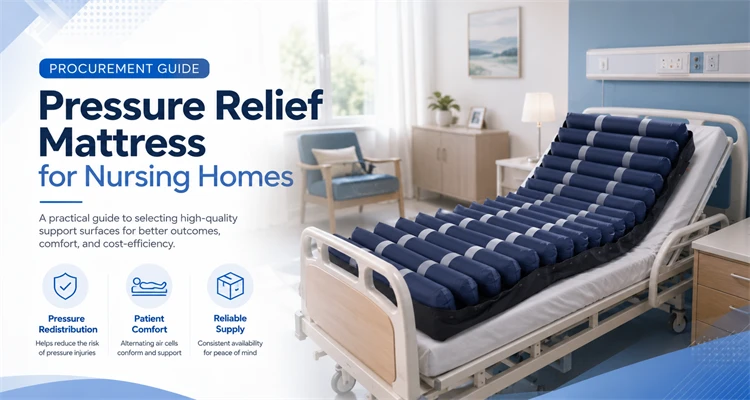
Pressure Relief Mattress Procurement Guide for Nursing Homes

When choosing a pressure relief mattress, nursing homes need to consider resident risk, length of bed use, the severity of pressure injuries, and their budget and capacity for maintenance, staff training, and supplier support.

For nursing homes, a pressure relief mattress is more than a product. It is part of a whole system along with risk assessment, repositioning, skin monitoring, members of the nursing staff, infection control, and of course, the caregiver.

This guide explains how nursing homes can evaluate a pressure relief mattress for nursing homes before purchasing for long-term bedridden residents, higher-risk care areas, or facility-wide replacement programs.

Key Takeaway: A pressure relief mattress can assist in the redistribution of pressure but it cannot replace an assessment of the clinical care or monitoring of the patient’s skin. In such instances, nursing homes should evaluate the risk of their residents and give priority to purchasing the mattress system that best meets their needs.

1. Understand The Nursing Home Use Case

Nursing homes often find themselves having to care for persons in their bed for long periods, persons having poor mobility and in need of assisted repositioning, or persons with more than one medical condition, thereby, increasing the risk of pressure injuries exacerbated by issues such as moisture, friction, shear, impaired sensation, and poor nutrition.

Common Resident Risk Factors

  • Long-term bed rest or very limited mobility.
  • Difficulty changing position without caregiver help.
  • Fragile skin, reduced sensation, or poor circulation.
  • Moisture exposure from continence care needs.
  • Low body weight, poor nutrition, or dehydration risk.
  • Existing redness, skin breakdown, or pressure injury history.

Many nursing homes think that one mattress fits all, but this isn’t the best way to think about mattress risks. When making purchasing decisions, the mattress procurement team should collaborate with the clinical staff to determine which resident groups require different levels of support, be it basic foam, static air, alternating pressure, low air loss, or higher acuity surfaces.

2. Link Mattress Choice To Pressure Injury Risk

Procurement teams often refer to stages of pressure injury. While you don’t need to classify every wound, you should understand that every level of care has its own support surfaces and a reason for expedited clinical escalation.

Stage I-IV Considerations For Buyers

Pressure Injury Stage General Meaning Procurement Implication
Stage I Intact skin with persistent redness or visible change in a localized area. Early risk response matters. Consider better pressure redistribution and frequent monitoring.
Stage II Partial-thickness skin loss or shallow open area may be present. A higher-support surface may be needed with stronger care planning and wound review.
Stage III Full-thickness skin loss may extend deeper into tissue. Requires clinical management. Mattress procurement should support higher-risk care protocols.
Stage IV Full-thickness skin and tissue loss with deeper structures potentially exposed. High-acuity support, clinical oversight, and documented care workflow are essential.
Unstageable or deep tissue concern Depth or tissue damage may not be fully visible at first. Escalate to qualified clinical staff and avoid relying on mattress selection alone.

Mattress buying should not replace clinical judgment. Rather, a mattress should reduce localized pressure and assist nursing routines.

3. Choose A Mattress Level For Each Care Need

Nursing homes typically require product mixes rather than a single model. Each resident, room, and budget can reflect a different level of required pressure relief mattress.

Typical Mattress Levels

  • Foam pressure redistribution mattress for lower-risk residents.
  • Static air mattress or overlay for selected comfort and support needs.
  • Alternating pressure mattress for residents needing dynamic pressure redistribution.
  • Tubular alternating pressure system for higher support and longer use.
  • Low air loss or microclimate-focused surface where moisture and heat management are priorities.
  • Turning or repositioning mattress options where caregiver workflow and resident handling are major concerns.

Managing procurement by defining product categories based on resident care risk and staff workflow is the safest way to avoid the over procurement of lower-risk beds, while implementing the advanced support options needed for higher-risk residents.

4. Evaluate Pump Functions And Resident Comfort

When choosing powered mattress systems, the pump should be as carefully selected as the mattress. A noisy, confusing, or poorly matched pump can create staff complaints and resident discomfort.

Pump Features To Check

  • Pressure adjustment range suitable for different resident weights.
  • Alternating cycle time and pressure stability.
  • Static mode or max firm mode for care tasks where available.
  • Low pressure alarm and power failure alarm where available.
  • Noise level during night shifts.
  • Simple controls that caregivers can understand quickly.
  • Hose connector design, filter access, power cord, plug type, and mounting hook.

Nursing homes should trial the device in a quiet room before deciding on a purchase. The staff should ensure that the alarms are understandable, assess if the pump will be too loud during the night, and evaluate the complexity of the whole setup.

5. Check Cover Material, Cleaning, And Infection Control Needs

Mattress covers matter in nursing homes because cleaning and infection control are daily concerns. A cover should support routine cleaning, reduce fluid ingress risk, and remain durable after repeated use.

Cover Checklist

  • Waterproof or fluid-resistant surface appropriate for care environments.
  • Wipe-clean guidance and disinfectant compatibility where available.
  • Strong seams, zipper protection, and cover fit after inflation.
  • Low-noise surface for resident comfort.
  • Anti-slip bottom or fixing straps where relevant.
  • Replacement cover availability for long-term use.

A low-cost mattress can become expensive if covers tear easily, absorb fluids, or cannot be cleaned according to facility routines. Maintenance and infection control staff should be included in sample testing.

Practical Tip: After the staff has had time to do a maintenance procedure on the sample, assess if any design flaws have impeded the normal maintenance practices that would be expected. Drop the supplier if the cover surface is difficult to wipe, the zipper catches, or the cover shifts.

6. Plan The Budget Beyond Unit Price

Budget planning should include more than the unit price. Nursing homes should calculate the total cost of ownership, including pumps, covers, spare parts, repair needs, staff training, warranty process, and replacement cycles.

Budget Items To Include

  • Initial mattress and pump cost.
  • Replacement covers, air cells, hoses, filters, and connectors.
  • Spare pumps for urgent replacement.
  • Cleaning time and staff workflow impact.
  • Warranty terms and repair process.
  • Expected replacement cycle based on use intensity.
  • Training time for nurses, caregivers, and maintenance staff.

The lowest price may not be the best value if the mattress requires frequent replacement or if staff cannot use it correctly. A practical budget should balance purchase price, durability, maintenance, and resident care needs.
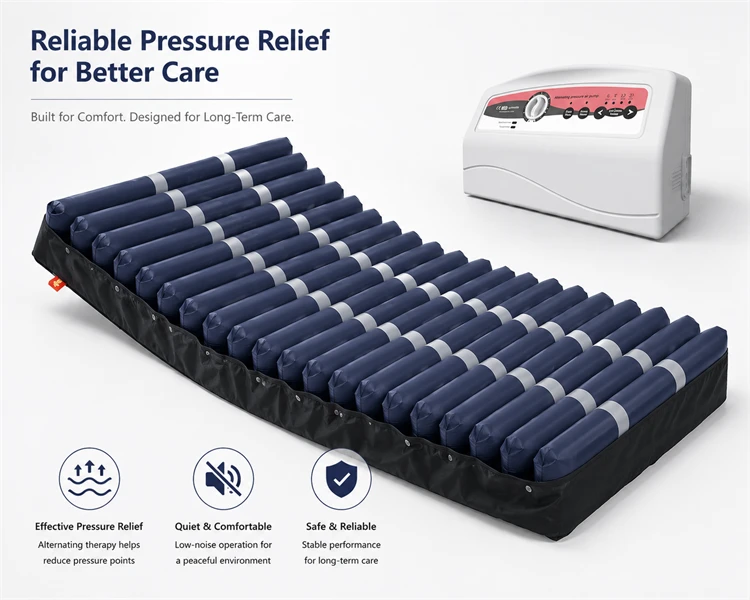
pressure relief mattress

7. Build A Maintenance Plan Before Purchase

A pressure relief mattress system only works well when it is maintained. Procurement teams should ask suppliers about cleaning, inspection, storage, spare parts, and troubleshooting before placing an order.

Maintenance Checklist

  • Daily visual checks for cover damage, hose disconnection, and alarm status.
  • Regular cleaning instructions and approved cleaning agents.
  • Pump filter inspection or replacement schedule.
  • Air leakage checks for cells, tubes, connectors, and valves.
  • Storage instructions for spare mattresses and pumps.
  • Spare parts list and replacement lead time.
  • Clear process for reporting failures or service issues.

Maintenance should be simple enough for real nursing home routines. If a product needs complex repair steps, hard-to-find spare parts, or unclear troubleshooting, it may not be the best choice for a busy facility.

8. Train Staff Before Facility-Wide Use

A mattress with pressure sores can quickly become a poorly chosen mattress if the staff does not understand use of the product, adjusting the pressure, alarm response, cleaning the system, and monitoring. Training should be factored into planning.

Training Topics For Nursing Homes

  • Which residents should use each mattress type.
  • How to set up the pump, hose, CPR valve, and cover.
  • How to adjust pressure according to facility policy and clinical guidance.
  • How to respond to low pressure alarms or power interruptions.
  • How to clean and inspect the mattress between residents.
  • How to document problems, escalate concerns, and request replacement parts.

Training materials must be concise, illustrative, and easy to replicate for new employees. Managers will benefit from suppliers who offer guides and quick-start videos with clearly labeled installations.

9. Compare Suppliers With A Procurement Scorecard

Nursing homes must use a prepared scorecard when comparing prospective suppliers. This provides objective assessments, and the care, procurement, and maintenance teams will be able to evaluate the same criteria.

Procurement Area What To Check Why It Matters
Resident fit Risk level, long-term bed use, comfort, and care setting. Matches mattress choice to nursing home needs.
Clinical workflow Repositioning, skin checks, alarm response, and documentation. Supports daily pressure care routines.
Product design Mattress type, pump, cover, air cells, CPR valve, and accessories. Determines usability and durability.
Maintenance Cleaning, spare parts, storage, troubleshooting, and repair process. Reduces downtime and service issues.
Budget Unit price, spare parts, warranty, replacement cycle, and training time. Shows true cost beyond purchase price.
Supplier support Samples, manuals, OEM options, documents, inspection, and after-sales response. Improves long-term procurement stability.

Creating a scorecard provides a rational basis for making a purchase decision. It helps to elucidate why a specific mattress is more appropriate for high-risk rooms whereas another model is more appropriate for lower-risk residents.

10. Confirm Supplier Documents And Sample Testing

Nursing homes or their purchasing agents should request documents and sample tests specific to the model before making a bulk purchase. Documentation and tests should be based on the exact model, pump, cover, and targeted market.

Documents And Sample Checks

  • Product specification sheet with mattress and pump configuration.
  • User manual, cleaning instructions, labels, and warning information.
  • Quality management or certification files where applicable to the model and market.
  • Packaging details, carton labels, and accessory list.
  • Sample test notes for pump noise, pressure stability, cover fit, and cleaning.
  • Warranty process, spare parts list, and after-sales contact route.

For nursing homes building a repeatable pressure relief mattress procurement checklist, the approved sample and document pack should become the reference for future orders.

Conclusion

Nursing homes should start the pressure relief mattresses procurement process with an understanding of resident risk and care workflow. Unit price should be considered last. It is the best long-term solution for giving residents comfort and staff ease of maintenance.

Typically, the most informative decision takes the most factors into account: focus on the different levels of need across residents for the mattresses, user-tested samples, and maintenance requirements. Staff training and model-specific documents should also be classified as integral. Senyang is ready and capable to support the pressure relief mattress projects of selected nursing homes and distributors, including OEM configurations of pumps, covers, and materials, alongside model-based documentation, instructional materials, and support.

FAQ

What Type Of Pressure Relief Mattress Do Nursing Homes Need?

Nursing homes generally require multiple options. Lower risk residents typically use simpler pressure redistribution surfaces, while higher risk residents who are long-term bed bound may require dynamic alternating pressure or higher support systems.

Can A Pressure Relief Mattress Prevent All Pressure Injuries?

No. While a mattress may assist with pressure redistribution, it is not a substitute for a clinical assessment, repositioning, skin checks, moisture management, nutrition, and the care routines of trained personnel.

How Should Nursing Homes Consider Stage I-IV Pressure Injuries?

Purchasing teams should understand that the more advanced stages typically require greater medical and managerial controls. Selection of mattresses should be in support of, and not a substitute for, a professional judgement call for wound care.

What Budget Factors Matter Besides Unit Price?

Budget should include additional covers, pumps, hoses, filters, repairs, the warranty process, the replacement cycle, the storage and cleaning workflow, and the time for staff training.

Why Is Staff Training Important After Purchase?

Training helps staff orient themselves for proper set up, pressure adjustments, alarm responses, proper cleaning, monitoring of residents, and reporting of maintenance issues.
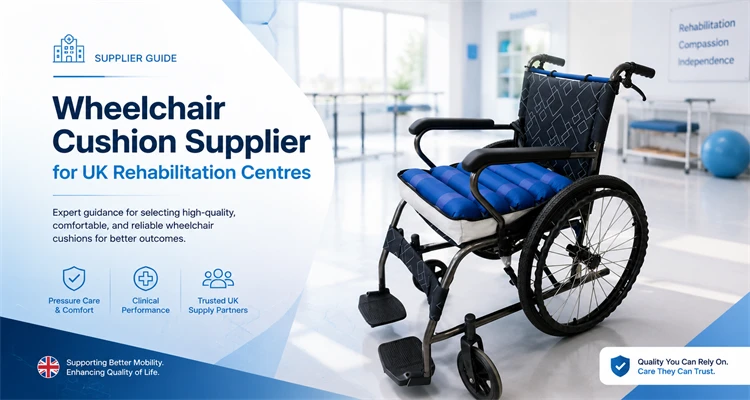
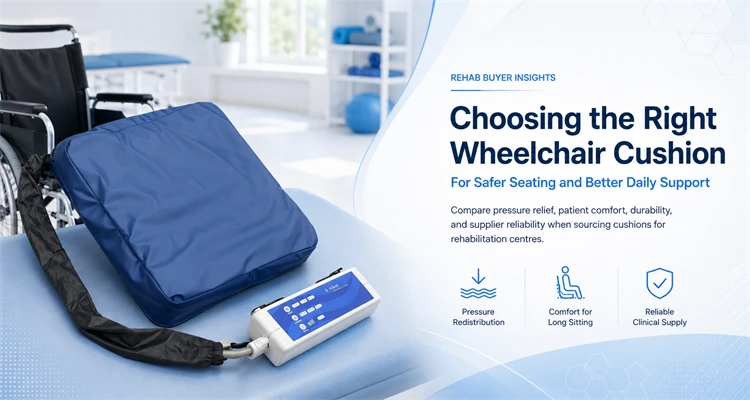
Wheelchair Cushion Supplier Guide for UK Rehabilitation Centres

Before considering suppliers for wheelchair cushions, UK rehabilitation centres should assess the pressure redistribution support, TPU/PVC/gel/foam options available, long sitting needs, clinical seating scenarios, documentation, cushion cleaning, cushion packaging, and sales support.

Wheelchair cushions provide an essential element of seat support in rehabilitation environments. For users who sit for prolonged periods, cushions impact comfort, pressure distribution, posture support, confidence during transfers, cushion cleaning, and staff confidence.

This guide explains how UK rehabilitation centres and medical distributors can evaluate a wheelchair cushion supplier before approving samples, adding a product line, or preparing bulk procurement.

Key Takeaway: A wheelchair cushion can support pressure redistribution and seated comfort, but it should not be presented as a guaranteed pressure ulcer prevention solution. Supplier selection should consider user risk, material, structure, size, documentation, cleaning, and clinical workflow.

1. Understand The UK Rehabilitation Use Case

Most rehabilitation centres support users who either have sitting as a primary element of therapy, mobility training, or activities of daily living as part of their post-acute recovery. For some users, the centre has to account for reduced mobility and/or reduced sensation, posture challenges, and a history of skin risk.

Clinical Scenario Questions

  • Will the cushion be used in a rehabilitation centre, wheelchair service, care facility, or home follow-up setting?
  • How long does the user typically sit each day?
  • Does the user need pressure redistribution, posture support, stability, or basic comfort?
  • Will therapists, nurses, carers, or family members adjust or inspect the cushion?
  • Does the supplier provide cleaning guidance, documentation, and replacement parts for UK buyers?

A reliable supplier will help the buyer choose the appropriate cushion in consideration of the user’s needs instead of recommending one model for each clinical case. Long sit time, transfer ability, and wheelchair fit are all important.

2. Compare TPU, PVC, Gel, And Foam Cushion Options

Cushions are available in foam, Gel, PVC, and TPU, each serving different clinical and commercial functions. UK rehabilitation centers and distributors should consider behavior, durability, ease of cleaning, comfort and the level of price when using various cushion materials.

Cushion Type Typical Strength Buyer Consideration
TPU air cushion Flexible air support with premium positioning and good user comfort potential. Check air retention, sealing quality, repair options, cover fit, and MOQ.
PVC air cushion Cost-effective air cushion option for basic or value-focused channels. Test odor, feel, durability, air leakage, and long-term use comfort.
Gel cushion Can offer stable seating feel and localized pressure support. Review weight, heat retention, cover protection, leakage risk, and cleaning workflow.
Foam cushion Simple, stable, and familiar for many rehabilitation settings. Check density, contouring, pressure redistribution, bottoming-out risk, and replacement cycle.
Hybrid cushion Combines foam, gel, air, or contour layers for balanced support. Confirm structure, user group, cleaning, replacement parts, and clinical positioning.

No single material is best for every user. The right choice depends on sitting duration, skin risk, posture, wheelchair fit, user weight, maintenance ability, and budget.

3. Review Pressure Redistribution And Pressure Ulcer Risk

The UK advises that those who sit in wheelchairs for extended periods of time, particularly those who are at risk of developing pressure ulcers, should be provided with cushions that redistribute pressure. However, cushion buyers should not be overly optimistic when assuming that cushions will redistribute pressure, as proper user assessment and care plans should be developed and implemented.

Pressure Care Review Points

  • Does the cushion increase contact area and reduce localized pressure points?
  • Is it suitable for users who sit for prolonged periods?
  • Does the supplier explain bottoming-out risk and inflation checks where relevant?
  • Can the cushion support stable posture during rehabilitation activities?
  • Are cleaning and cover replacement instructions clear?
  • Does the supplier avoid unsupported claims such as guaranteed prevention?

In terms of care, cushions should accompany professional skin care, repositioning, management of skin moisture, nutrition, and the proper evaluation of a seating system as part of a comprehensive care plan. A cushion is not the sole element of a care plan.

4. Match Cushions To Long Sitting And Clinical Scenarios

Long periods of sitting differ from short-term comfort seating. Rehabilitation centers must consider cushion types for varying sitting times. Factors such as activity, transfer ability, skin status, and posture must be accounted for as well.

User Groups To Consider

  • Wheelchair users who sit for several hours each day.
  • Post-acute rehabilitation users rebuilding mobility.
  • Older adults with limited movement or fragile skin.
  • Users with posture asymmetry or stability needs.
  • Users who need carer-assisted transfers.
  • Discharge planning users who need home follow-up equipment.

Supplier conversations should include the user’s clinical setting, not only cushion dimensions. If the cushion will be used in therapy rooms, wards, outpatient services, or home discharge kits, the requirements may differ.

wheelchair cushion supplier

5. Check Cushion Structure, Size, And Load Capacity

A wheelchair cushion supplier should provide clear specifications by exact model. Vague descriptions such as standard size or high load are not enough for rehabilitation procurement.

Specification Checklist

  • Cushion width, depth, and height after setup or inflation.
  • Available sizes for common wheelchair seat widths.
  • Rated load capacity or recommended user weight range.
  • Cell height, contour design, gel layer, or foam density where relevant.
  • Anti-slip base and cover fit.
  • Valve, pump, repair kit, and accessory details for air cushions.
  • Replacement cover and spare part availability.

UK rehabilitation centres should test whether the cushion fits the wheelchair, remains stable during transfers, and supports the user’s seated posture. A cushion that is too high, too narrow, or too unstable may create new problems.

6. Review Covers, Cleaning, And Infection Control

Covers are important in rehabilitation centres because cushions may be used repeatedly and cleaned often. The cover should protect the cushion, support hygiene routines, and remain comfortable for the user.

Cover Checklist

  • Wipe-clean or washable cover guidance.
  • Water-resistant or fluid-resistant properties where relevant.
  • Breathable fabric for long sitting comfort.
  • Anti-slip base to reduce cushion movement.
  • Zipper strength and easy cover removal.
  • Replacement cover availability for facility use.
  • Labeling and washing instructions suitable for UK users.

A supplier should provide cleaning instructions that match the intended setting. Rehabilitation teams should include clinical, cleaning, and stores staff in sample evaluation where possible.

Buyer Tip: Ask for a complete packed sample and test the cover as staff would use it: remove it, clean it, refit it, check the label, and confirm whether replacement covers are available.

7. Confirm UK Market Documentation

Documentation should be reviewed before the supplier wants to sell products. However, those needs will not be the same across rehabilitation centres and distributors within the UK.

Documentation Checklist

  • Product specification sheet by exact model.
  • Instructions for use and cleaning guidance.
  • Label files, packaging information, and warning statements.
  • UKCA, CE, or other conformity information where applicable to the product and market.
  • Quality management information where applicable.
  • Batch, traceability, and complaint-handling process.
  • Private-label document control for distributor brands.

UK rehabilitation centres within a passive category should receive documentation striking a balance across the category. However, comfort products become an exception compared to cushions for the strategic clinical pressure care category.

8. Evaluate Supplier Support For Medical Distributors

The majority of rehabilitation centres in the United Kingdom use distributors for purchasing. Therefore, the supplier should expect support in the form of packaging, documentation, and private-label products.

Distributor Support Checklist

  • Retail packaging, neutral packaging, or private-label packaging.
  • Barcode, SKU, carton marks, and size labels.
  • Manual language and user-facing instructions.
  • Sample support and approval records.
  • MOQ by material, size, cover, and packaging.
  • Lead time for mixed-size orders.
  • After-sales support for covers, pumps, repair kits, or replacement parts.

A quality cushion vendor provides initial clarity to distributors and employs straightforward use, care, package, and size info to minimize returns.

9. Use A Supplier Evaluation Scorecard

The scorecard offers a way for rehabilitation centers and distributors to objectively rank wheelchair cushion providers, substantiating a supplier’s capacity for clinical or commercial utilization.

Evaluation Area What To Check Why It Matters
Material TPU, PVC, gel, foam, hybrid layers, cover fabric, and durability. Affects comfort, pressure distribution, cost, and maintenance.
Clinical fit Long sitting, skin risk, posture, transfer ability, and user group. Matches cushion type to rehabilitation scenarios.
Specifications Size, height, load capacity, cell design, foam density, gel layer, and stability. Reduces mismatch with wheelchairs and users.
Cleaning Cover removal, wash guidance, fluid resistance, labels, and replacement covers. Supports infection control and facility workflow.
Documentation IFU, labels, UKCA/CE information where applicable, traceability, and claims. Reduces procurement and compliance uncertainty.
Supply support Samples, MOQ, packaging, lead time, spare parts, and after-sales response. Protects distributor and facility purchasing stability.

Buyers can score each supplier from 1 to 5 and keep sample notes, photos, cleaning feedback, user comments, and document files as evidence.

10. Avoid Common Supplier Selection Mistakes

  • Choosing a cushion only by price or appearance.
  • Using pressure ulcer prevention claims that the product documents do not support.
  • Ignoring long sitting comfort and posture stability.
  • Failing to test the cushion with the target wheelchair.
  • Skipping cover cleaning and replacement cover checks.
  • Accepting general documents without checking the exact model and market.
  • Ordering bulk quantities before sample approval.

For buyers building a wheelchair cushion procurement checklist, the best process is to test samples, confirm documentation, check cleaning, review packaging, and match each cushion to the intended clinical scenario.

Conclusion

There should be a careful balance of TPU/PVC/gel/foam options, pressure redistribution support, cleaning, documentation, size, load, and supply support to determine the most appropriate cushion for rehabilitation centers within the UK.

Choosing the right cushion for the user, not just the lowest-cost product, is what a good supplier is concerned with. Senyang provides support on the provision of wheelchair cushions and pressure relief post cushions.

FAQ

What Should UK Rehabilitation Centres Check In A Wheelchair Cushion Supplier?

Pressure redistribution support, size, load, cleaning, covers, cushion structure, materials, samples, documentation, and after-sales support.

Which Cushion Material Is Best For Long Sitting?

There is no single best material. TPU, PVC, gel, foam, and hybrid designs can all be suitable depending on user risk, posture, sitting time, maintenance, and budget.

Can Wheelchair Cushions Prevent Pressure Ulcers?

Wheelchair cushions may support pressure redistribution, but they should not be described as guaranteed prevention. Risk assessment, repositioning, skin checks, and clinical guidance remain important.

Why Is Cover Cleaning Important In Rehabilitation Centres?

Covers affect hygiene, comfort, durability, and day-to-day workflow. Rehabilitation centres should test cleaning, refitting, labeling, and replacement cover availability.

What Documentation Should A Supplier Provide For UK Buyers?

Suppliers should provide model-specific specifications, instructions for use, cleaning guidance, labels, conformity information where applicable, traceability details, and packaging files.

How to Choose a Medical Air Mattress Supplier for UK Care Homes

Care homes in the UK are recommended to choose a medical air mattress supplier that fulfills the requirements of their pressure care products, offers transparent documentation, guarantees steady lead times, provides timely after sales assistance, incorporates useful functions in their pumps, includes easily cleaned covers, and provides stable bulk purchasing assistance.
When purchasing a medical air mattress, care homes in the UK are purchasing more than just a product. They are purchasing pressure care planning, comfort of the resident, infection control, staff workflow, long-term equipment management, and more. A poor supplier can damage a care home with delayed parts, ambiguous documentation, difficult maintenance, loud pumps, and poor mattress consistency.

This guide explains how care home operators, procurement teams, distributors, and equipment buyers can evaluate a medical air mattress supplier before purchasing for resident rooms, nursing units, or group care facilities.

Key Takeaway: A suitable supplier for UK care homes should be evaluated by product fit, documentation, lead time, after-sales support, pump performance, cover quality, cleaning guidance, and bulk order reliability, not by price alone.

1. Start With The Care Home Use Scenario

Before comparing suppliers for the purchase of mattresses, be specific about the scenario of usage. The features of the product may differ for a small residential care home and a nursing home dealing with residents who may be at a higher risk of pressure injuries or require prolonged placement in bed.

Questions To Clarify First

  • Will the mattress be used for short-term support or long-term resident care?
  • Does the care home need basic bubble systems, tubular alternating systems, or higher-spec mattress systems?
  • Will staff need simple controls for frequent room changes?
  • Are replacement covers, pumps, hoses, and accessories required locally or from the supplier?
  • Does the product need to fit existing bed frames and room workflows?

Defining the scenario to the level of care required helps eliminate the tendency to purchase one generic model for the residents. Given the different risk and comfort levels, as well as staffing and budget planning, a care home may require multiple options to cater to all residents.

2. Check Supplier Qualifications And Documentation

For care homes in the United Kingdom, purchasing suppliers should be requested to provide basic product information, including documentation regarding the product, prior to any purchasing. The documentation required will depend on the specific mattress model, the pump combination, the destination market, and if the product is provided to Great Britain or Northern Ireland.

UK Care Home Buyers should be wary of blanket statements such as all suppliers’ mattresses have the same certification. Rather, ask the supplier to devise a list of documentation applicable to the model being purchased. The buyers should also, based on the route and market to which the product is supplied, make considerations for UKCA, CE, and MHRA registration, user information, labeling, and traceability of the product as planning for the UK market.

Documents To Request

  • Product specification sheet with size, material, weight capacity, and compatible pump.
  • User manual and clear operating instructions for care staff.
  • Cleaning and maintenance guidance from the manufacturer.
  • Warranty terms and after-sales process.
  • Model-specific UKCA, CE, or other market documents where applicable.
  • Packing details, batch information, and replacement part availability.

3. Review Lead Time And Stock Availability

Lead Time And Stock Availability
Lead time is an important factor for care home procurement as there is a direct correlation between ongoing care and demand for mattresses, room turnover, and replacement planned. A supplier should be able to clearly define sample lead time, production lead time, stock availability, and delivery options.

Lead Time Questions

  • Are standard mattress and pump systems available from stock?
  • What is the normal delivery time for repeat orders?
  • How quickly can replacement pumps, hoses, and covers be supplied?
  • Does custom branding or packaging extend the lead time?
  • Can the supplier support scheduled bulk deliveries for multiple care home sites?

For larger care home groups, lead time planning should include spare units and replacement parts. Prior to purchase, it should be noted that a mattress that is not supported immediately after purchase may strain care home operations.

4. Evaluate After-Sales Support And Spare Parts

After-sales support is of high importance when considering suppliers for care homes. Staff need the ability to put equipment in service, with the option to be cleaned, maintained, and replaced with minimal delays. Suppliers should be able to outline a clear process for warranty claims, spare parts, replacement covers, pump troubleshooting, and repeat orders.

After-Sales Checklist

  • Warranty period for mattress and pump.
  • Availability of replacement pumps and hoses.
  • Availability of replacement waterproof covers.
  • Clear troubleshooting guide for common pump alarms or pressure issues.
  • Response time for after-sales questions.
  • Support for batch tracking and repeat purchase records.

Buyer Tip: Enquire with the supplier what their quick response times are with deliveries of replacement pumps or covers. For care homes the availability of spare parts is often as important as the price of the mattress itself.

Medical Air Mattress Supplier for UK Care Homes

5. Compare Pump Functions For Care Home Use

The pump is the working core of an alternating pressure mattress system. For UK care homes, pump functions should be easy for staff to understand, reliable during daily use, and suitable for resident comfort.

Pump Function What To Check Why It Matters In Care Homes
Cycle mode A/B or A/B/C alternating mode and cycle time. Affects pressure redistribution and resident comfort.
Pressure adjustment Manual knob, digital display, or preset levels. Helps staff match support to resident weight and comfort needs.
Low pressure alarm Visible or audible alert for pressure problems. Supports monitoring and quicker staff response.
Noise level Pump sound during continuous operation. Important for resident sleep and shared rooms.
Static mode Temporary static support where available. May help during care routines or repositioning where appropriate.
Connector design Secure hose connection and easy setup. Reduces setup errors and staff frustration.

Buyers should test the mattress and pump together before placing a bulk order. A good mattress paired with a weak or noisy pump can still create a poor care home experience.

6. Check Cover Material, Cleaning, And Maintenance

It is essential for the quality of the covers used as mattresses in care homes since mattresses must be cleaned and inspected and reused as per the local infection prevention protocols and the manufacturer instructions. While choosing the cover, practical aspects should be a greater concern than aesthetics brought by a catalog picture.

Cover And Cleaning Points

  • Waterproof or fluid-resistant cover performance.
  • Easy-to-clean surface and suitable closure design.
  • Zipper or snap quality and cover fit.
  • Replacement cover availability.
  • Manufacturer cleaning guidance for routine and between-resident use.
  • Inspection guidance for damage, wear, staining, or fluid ingress risk.

Cleaning and maintenance records are a must for the care home, according to the internal procedures. When in the selection of a supplier, inquire to clarify whether cleaning guidance is sufficient for training of the staff and whether ordering of replacement covers is simple.

7. Compare Mattress Structure And Resident Comfort

Care needs can be met by different structures of mattresses. Consider a short-term or lower-risk need for pressure redistribution, a basic bubble mattress may suffice. Medium-level cost applications utilize tubular alternating pressure mattresses, while greater demand residents may benefit from long-term use of higher support or system beds.

Mattress Features To Compare

  • Bubble, tubular, foam, multi-layer, or turning design.
  • Height, the number of cells, weight capacity, and bed size compatibility.
  • CPR quick release on suitable models.
  • Pillow function or static bottom layer where available.
  • Resident comfort, movement feel, and ease of transfer.

Wherever possible, care homes should trial samples with staff input. Staff usually detect issues like setup (and cover cleaning) time, pump noise, hose placement, and room workflow before these issues are included in procurement.

8. Plan Bulk Purchasing For Care Home Groups

Bulk purchasing may offer unit cost and standardization benefits, while also increasing the likelihood of procurement risk if the selected supplier is not appropriate. Care home groups should assess and weigh the level of price variance with product consistency, documentation, availability of spare parts support, and certainty of repeat orders.

Bulk Purchase Checklist

  • Confirm approved sample before bulk order.
  • Record exact model, pump, cover, and packaging specifications.
  • Agree carton labels, batch information, and delivery schedule.
  • Confirm spare parts and replacement cover quantities.
  • Ask whether staged delivery is available for multiple sites.
  • Keep a reference sample for future repeat orders.

For distributors catering to several care homes, additional bulk planning should include product training materials, spare pumps, after-sales support, and clear instructions for reordering.

9. Common Mistakes To Avoid

  • Choosing only by the lowest unit price.
  • Ignoring pump noise and alarm functions.
  • Not checking replacement cover availability.
  • Accepting broad certification claims without model-specific documents.
  • Skipping sample testing before bulk purchase.
  • Failing to confirm lead time for spare parts.
  • Using one mattress type for every resident need.

Conclusion

Undertaking a service procurement for a medical air mattress for care homes in the UK focuses beyond pricing. In addition, purchasers should assess the supplier’s specification, information, lead time, after-sales support, pump function, cover type, cleaning instructions, and bulk purchase service.

The safest approach is to test samples, confirm model-specific documents, review cleaning and maintenance guidance, and keep written specifications before placing a larger order. For buyers building pressure care equipment for UK care homes, supplier reliability will matter long after the first shipment arrives.

Senyang can accommodate private labeling, structural customization, volumetric color flexibility, choice of pump, and modified packaging to buyers needing support for the medical air mattresses and pressure care projects, specifically for the care-focused lines.

FAQ

What should UK care homes check before buying medical air mattresses?

Care homes should check product suitability, documentation, lead time, pump functions, cleaning guidance, replacement covers, after-sales support, and bulk purchase reliability.

Why is after-sales support important for care homes?

After-sales support helps care homes manage replacement pumps, covers, troubleshooting, warranty claims, and repeat orders without long service disruption.

What pump functions are useful for care homes?

Useful pump functions may include pressure adjustment, low pressure alarm, suitable cycle mode, quiet operation, secure connectors, and static mode where appropriate.

What should buyers check about mattress covers?

Buyers should check whether the cover is waterproof or fluid-resistant, easy to clean, well fitted, replaceable, and supported by clear manufacturer cleaning guidance.

How should care home groups manage bulk purchasing?

Care home groups should approve samples, record exact specifications, confirm lead time, plan spare parts, and keep a reference sample for repeat orders.