
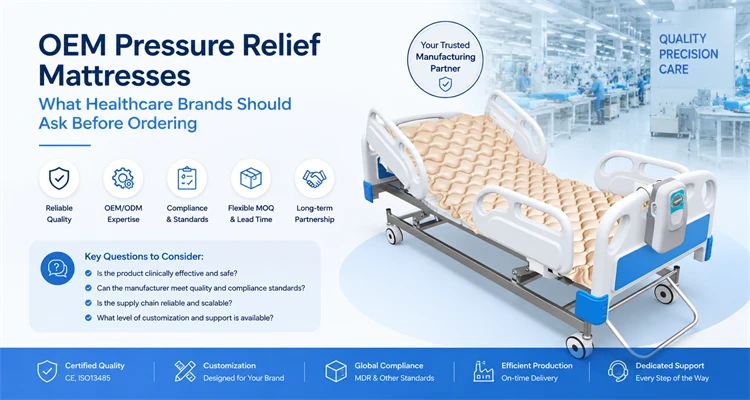
After market research, it was revealed that home care equipment companies, long-term care providers, and healthcare brands and distributors prefer to enter the pressure relief mattress market through OEM partnerships. These companies want to place their brand name on the product. More than just brand placement on a carton or pump, this choice impacts product placement, packaging language, documentation, and level of support for after sales and future orders.
With this guide, buyers have the ability to learn the most pertinent questions to ask before selecting an OEM pressure relief mattress manufacturer in order to reduce risk during mass production, sample approval, and artwork confirmation.
Key Takeaway: The first step towards a successful OEM purchase is a written specification. For healthcare brands, prior to production, the following must be agreed upon: testing criteria, packaging, user manuals, color, materials, size, placement of pump, and placement of sample.
1. Define The OEM Project Goal First
Healthcare manufacturers must first identify the goal of the OEM project before engaging in any price negotiations. These goals may include the development of a simple pressure care device that incorporates private-label packaging or an expansive line of pressure care products for distribution to pharmacies, nursing homes, and medical centers.
Questions To Clarify Internally
- Will the mattress be sold under your own brand or a customer-specific private label?
- Is the target channel home care, nursing home, hospital, rehabilitation, or distributor resale?
- Do you need one model or a product series at different price levels?
- Which country or region will the product be sold in?
- What documentation, labeling, plug type, and language requirements apply to that market?
The more specific the answers, the more possible the supplier configuration. A buyer interested in home care will more likely want a product that is more cost affordable and easier to set up. In contrast, a buyer focused on a facility will need stronger functionality from the pump, with options that ease cleaning and comprehensive documentation and explanation.
2. Confirm What OEM Customization Really Includes
OEM customization may cover visual branding, creation of unique/personalized packaging and different language options for your products. Configuration of the product, selection of pump options, inclusion of a mattress, and the addition of accessories and different types of branding. Suppliers are not providing all the same features for OEM services.
Common OEM Customization Options
- Logo on pump housing, mattress cover, carton, label, or user manual.
- Private-label packaging with brand color, barcode, model name, and carton marks.
- Mattress size, cell structure, cover material, color, and accessory options.
- Pump appearance, control panel, pressure range, alarm functions, and plug type.
- Multilingual user manuals, quick-start guides, warning labels, and insert cards.
- Shipping marks, packing method, carton dimensions, and pallet planning.
A practical OEM discussion should end with a specification sheet, not only a quotation. The specification should state what is fixed, what is optional, and what requires extra tooling, minimum order quantity, or longer lead time.
3. Review Private-Label Packaging Carefully
Packaging with a private label is often the first point of contact for a brand, and it is often the first part of the launch for a new product. Part of a brand’s packaging process for a new product includes the planning of the packaging design. However, the final design of the packaging should not be considered a design task in its own right.
Packaging Items To Approve
- Outer carton artwork, model name, product image, and brand information.
- Product label, serial or batch information, barcode, and shipping marks.
- Manual language, warnings, setup instructions, and maintenance notes.
- Accessory bag, pump protection, hose placement, and inner packing layout.
- Carton strength, dimensions, gross weight, and export packing method.
For a brand with a private label packaging system for medical mattresses, the safest means of avoiding errors with packaging and product information is to consider the design of packaging and packaging samples for the product before proceeding to production. This process mitigates the risk of errors occurring as a result of mismatched logos and packaging, inappropriate language, and erroneous information.
Buyer Tip: Maintain an organized, final approved packaging file, along with packaging artwork, barcodes, marks, manual versions, product label versions, and product images. Use the same file as the reference for all subsequent purchases.
4. Specify Mattress Size And Structure
Healthcare providers often vary the size, cell design, material, thickness, and intended use of pressure relief mattresses. If the size is not clearly defined, the final outcome is likely to not fit the intended bed frame/cover/carton or meet market expectations.
Size And Structure Details To Confirm
- Inflated and uninflated mattress size.
- Compatible bed width and length.
- Bubble, tubular, or multi-layer structure.
- Number of cells or tubes where relevant.
- Mattress height, edge design, and CPR valve if available.
- Maximum user weight guidance provided by the supplier.
- Hose position and pump connection method.
Buyers should also confirm whether the same product size will be used across all countries. Some markets may expect different bed sizes, plug types, languages, and packaging formats.
5. Choose Pump Functions Based On The User Setting
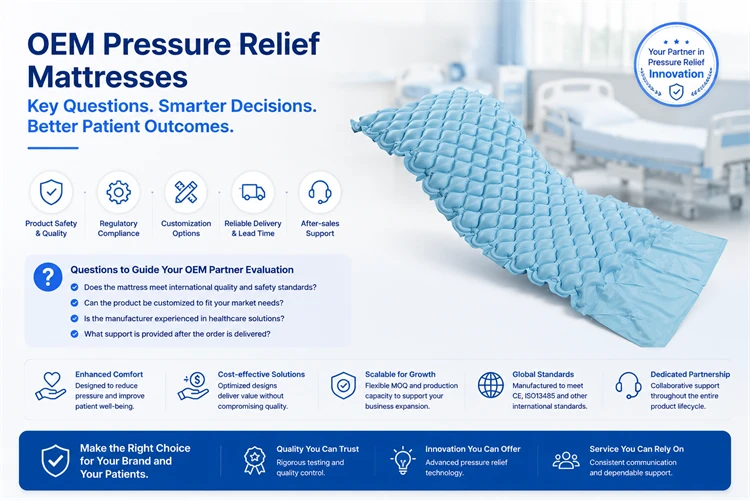
A product’s pump affects the consumer’s perception of the product’s system functionality, caregiver’s workflow, comfort levels, satisfaction levels, and even the consumer’s overall satisfaction with the product. A mattress may even perform well with a good air cell and cover, but a pump that is either weakly matched with a product or poorly matched may generate consumer complaints.
Pump Options To Compare
- Pressure adjustment range and control method.
- Cycle time and alternating mode.
- Static mode, max firm mode, or seat inflation mode where available.
- Low pressure alarm, power failure alarm, or service indicators.
- Noise level for night use and care facility environments.
- Pump mounting hook, hose connector, filter, and power cord details.
- Voltage, plug type, labeling, and target-market electrical requirements.
Buyers should evaluate all aspects of an inflating mattress to fully understand the pump including pump noise, time for full inflation, and user settings to determine the intents of the controls.
6. Decide Color And Appearance Without Hurting Usability
Using color helps a company create brand identity and a consistent product line, but it should not come at the expense of usability. In all cases, the pump panel and mattress cover should help staff and look professional in a nursing or home care environment.
Color Decisions To Review
- Mattress cover color and stain visibility.
- Pump shell color and control panel contrast.
- Logo color on cover, pump, carton, and manual.
- Label readability under normal lighting.
- Whether custom colors require MOQ, extra cost, or longer lead time.
For professional healthcare channels, a restrained color system often works better than a highly decorative one. Buyers should request color samples or printed proofs before approving bulk production.
7. Control User Manuals And Language Versions
User guides, part of the product experience, can help control errors, reduce service pressure, and help reduce unexpected complaints. For OEM projects, brands should confirm who writes, translates, reviews, and approves the manual.
Manual Files To Check
- Product setup steps with pump and mattress connection instructions.
- Cleaning, storage, and maintenance guidance.
- Troubleshooting for low pressure, alarms, or inflation problems.
- Safety warnings written in clear target-market language.
- Model name, accessory list, warranty process, and customer support wording.
- Version number and approval date for repeat-order control.
Each instruction manual being shipped should correspond to each model. Covers, hoses, alarms, and packs, and additions.
8. Use Sample Testing Before Bulk Orders
Sample testing is the buyer’s opportunity to confirm whether the OEM pressure relief mattress works as expected before committing to production. The goal is not only to see the product, but to test the complete user experience.
Sample Test Checklist
- Measure mattress size after inflation.
- Test inflation speed and alternating cycle.
- Check air leakage after extended inflation.
- Listen to pump noise in a quiet room.
- Review alarm functions and pressure adjustment.
- Clean the cover surface and inspect seams, zipper, and hose connection.
- Open the carton and check packaging protection, manual, labels, and accessories.
- Record photos and written comments before approving final specifications.
Healthcare brands should approve a sealed reference sample or detailed sample report. This becomes the baseline for quality inspection and repeat-order comparison.
9. Compare OEM Order Items Before Approval
| Order Item | What To Confirm | Why It Matters |
|---|---|---|
| Branding | Logo position, color, size, and file format. | Prevents inconsistent brand appearance. |
| Packaging | Carton artwork, label, barcode, manual, and inner packing. | Reduces shipment and market-entry errors. |
| Mattress | Size, structure, material, hose, valve, and cover. | Keeps the product aligned with user needs. |
| Pump | Pressure range, cycle mode, alarms, plug, and voltage. | Protects usability and target-market fit. |
| Manual | Language, model details, setup steps, and version control. | Reduces after-sales questions and setup mistakes. |
| Sample | Testing results, approved photos, and reference sample. | Creates a clear standard for bulk production. |
This table should be converted into an approval checklist before placing an OEM order. Any change after approval should be documented in writing.
10. Ask About MOQ, Lead Time, And Repeat Orders
Inquire About MOQ, Lead Time, and Repeat Orders
This depends on the customization involved, where a simple logo may take much less time than, say, a new color or a new pump panel, new packaging, new box design, etc. Buyers should identify the changes that affect costs and timing.
Commercial Questions To Ask
- What is the MOQ for each OEM item?
- Which customization items require extra tooling or artwork fees?
- How long does sample production take?
- How long does mass production take after final approval?
- Can the supplier support mixed models in one order?
- How are repeat orders checked against the approved sample?
- What spare parts or replacement pump support is available?
Good OEM suppliers should be able to walk you through the first-order process and the repeat-order process. For healthcare brands, having the consistency over time is often more important than the first-order price, even if it is a little cheaper.
Conclusion
OEM pressure relief mattresses should be ordered with a clear specification, approved sample, confirmed packaging, correct language files, suitable pump functions, and documented quality expectations. Healthcare brands that define these details early are more likely to avoid delays, rework, and inconsistent repeat orders.
When comparing suppliers, ask for practical evidence: sample reports, packaging proofs, model-specific documents, production capacity, inspection steps, and repeat-order controls. Senyang can support selected OEM and private-label pressure relief mattress projects, including mattress configuration, color options, pump choices, packaging, manuals, and related customization requirements.
FAQ
What Can Be Customized In An OEM Pressure Relief Mattress Order?
Typical items in OEM orders include, but are not limited to, logos, packaging, mattress dimensions, cover/case colors, pump functionality, user guides, labels, packaging/carton markings, plugin types, and certain accessories.
Should Healthcare Brands Test Samples Before Ordering?
Yes. Sample testing helps confirm size, inflation performance, pump noise, alarm behavior, material quality, packaging protection, and manual accuracy before bulk production.
Is Private-Label Packaging Only About Carton Design?
No. Private-label packaging encompasses not only carton artwork but also product labels, barcodes, user manuals, cards, warning labels, inner packing, shipping markings, and versions.
Why Is Pump Selection Important For Pressure Relief Mattresses?
The pump controls inflation, pressure adjustment, alternating cycles, noise level, and alarm functions. A poorly matched pump can create usability problems even when the mattress looks acceptable.
How Can Brands Keep Repeat OEM Orders Consistent?
Brands should keep approved specifications, artwork files, manual versions, sample photos, inspection standards, and reference samples for comparison with future orders.