
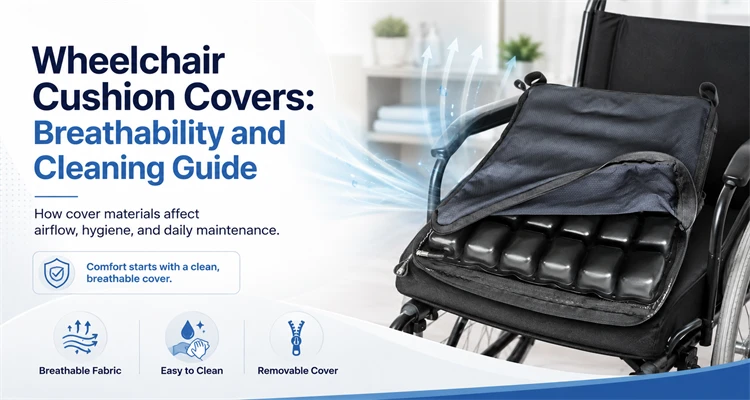
A wheelchair cushion cover is the working interface between the user, the cushion core, and daily cleaning. Its fabric, stretch, moisture barrier, seams, zipper, and non-slip base can affect heat and moisture management, cushion contour, seating stability, cleaning time, and protection of foam, gel, or air cells.
Breathability and waterproofing are not simple opposites. Some covers use a breathable stretch top with a fluid-resistant inner layer or base, while others prioritise wipe-clean protection. The best fit depends on moisture exposure, skin condition, sitting time, cushion design, laundering access, and how quickly a replacement cover can be fitted.
1. Why the Cushion Cover Affects Daily Use
The cover protects the cushion core from dirt, abrasion, and fluid, but it also changes how the surface feels and responds. A stiff cover can bridge across a contour or air-cell valley. A loose cover can wrinkle beneath the pelvis. A damaged moisture barrier can allow fluid to reach foam or internal layers.
For this reason, a replacement cover should match the cushion model, size, shape, and fastening system. A generic cover that fits around the outside may still alter the intended immersion, stability, valve access, or orientation of the cushion.
2. Breathable Covers and Temperature Management
Breathable fabrics allow air or water vapour to move through part of the cover. Spacer mesh, knitted polyester, and stretch textile panels are common approaches. They may feel less warm during prolonged sitting and can reduce the enclosed feeling of a fully coated surface.
Breathability does not mean that the cushion stays dry under every condition. Sweat, spilled drinks, urine, cleaning moisture, and damp clothing can still reach the surface. A porous top may also require a separate fluid-resistant layer beneath it.
When Breathability Is Valuable
- Long sitting periods in warm indoor environments.
- Users who report heat build-up or surface dampness.
- Cushions whose contour or air cells need a flexible stretch cover.
- Care routines where removable covers can be washed and dried promptly.
- Low to moderate fluid exposure with a protected cushion core.
Check the complete construction rather than the fabric name alone. A breathable top combined with an impermeable lower laminate may manage moisture differently from an open mesh cover with no internal barrier.
3. Waterproof and Water-Resistant Cover Designs
A waterproof or water-resistant layer helps stop liquid from entering the cushion core. This can be especially important for foam, layered cushions, and situations with regular spill or continence exposure. Protecting the core can simplify cleaning and reduce the chance of moisture remaining inside the cushion.
The terms waterproof, water-resistant, fluid-resistant, and wipe-clean should not be treated as interchangeable without a product specification. Performance depends on the coating or membrane, seam construction, zipper protection, wear, stretching, and the amount and duration of fluid contact.
Trade-Offs to Check
- A coated surface may feel warmer than an open textile cover.
- Repeated folding or abrasion may damage the barrier over time.
- Fluid can enter through an exposed zipper or damaged seam even when the fabric is waterproof.
- A stiff laminate may restrict deep contours or high air cells.
- Moisture can remain between the user and a waterproof surface if spills are not removed quickly.
4. Stretch and Conformability Matter as Much as Fabric Type
The cover should follow the working shape of wheelchair pressure relief cushions. Two-way or four-way stretch can help the fabric move with foam contours, gel sections, or individual air cells instead of forming a tight hammock above them.
Too little stretch can reduce immersion and change where pressure is carried. Too much loose fabric can fold, bunch, or allow the cushion to move inside the cover. The correct balance is model-specific.
- Check that the cover reaches the bottom edges without excessive tension.
- Make sure seams do not sit beneath the main pelvic loading area.
- Confirm that air cells can rise and separate normally.
- Observe whether the cover develops wrinkles after the user transfers or shifts weight.
- Use the original or approved replacement cover when the cushion design depends on contour conformity.
5. Zipper Design and Fluid Entry Points
A zipper makes the cover removable, but it is also a potential route for fluid and debris. Location matters. A zipper positioned away from the top sitting surface and protected by a flap is easier to manage than an exposed opening beneath the user.
Zipper Checks
- Slider moves smoothly without pulling or separating the teeth.
- Zipper closes completely around corners and contours.
- Protective flap lies flat and is not trapped inside the closure.
- No fraying, broken stitching, corrosion, or dried contamination is present.
- The pull tab cannot create a pressure point or catch on the wheelchair.
- Valve openings and access panels close correctly after cushion adjustment.
Closing the zipper is part of correct setup, not only appearance. An open section can let the core shift, expose internal material, or allow liquid to bypass the main cover surface.
6. Non-Slip Bases and Wheelchair Stability
The underside of a cushion cover may use textured fabric, coated material, hook-and-loop straps, or another fastening method. Its purpose is to keep the cushion correctly oriented and centred during propulsion, transfers, braking, and weight shifts.
A very grippy base cannot correct a cushion that is the wrong size or a sling seat that lacks the required insert. It should work with the chair base without bunching the cover or preventing the cushion from being removed for cleaning.
- Check cushion movement after each transfer.
- Confirm fasteners attach to the intended wheelchair surface.
- Remove lint and debris that reduce grip or interfere with hook-and-loop material.
- Inspect coated bases for peeling, cracking, or hardening.
- Keep the cover label, arrow, or front marking visible for correct placement.
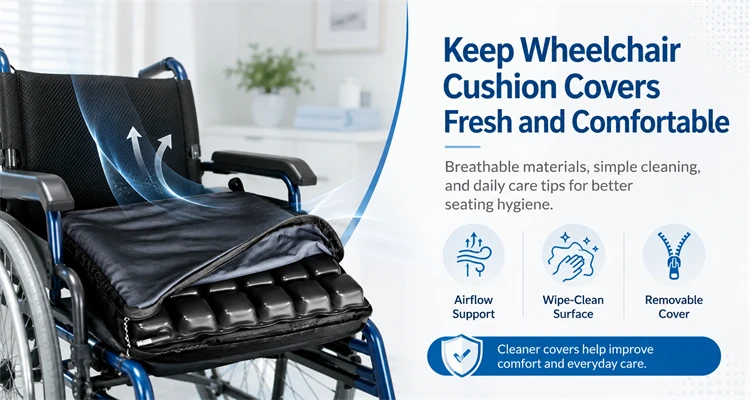
7. Compare Cover Constructions by Care Need
| Cover Construction | Main Advantage | Main Limitation | Daily Check |
|---|---|---|---|
| Breathable textile | Air and vapour movement with a softer feel | Lower fluid protection unless a barrier is added | Moisture, wrinkles, drying, and core condition |
| Water-resistant stretch fabric | Balances conformity with limited fluid protection | Barrier performance depends on wear and seams | Cracks, delamination, zipper, and stretch |
| Waterproof wipe-clean cover | Strong protection from routine spills | May retain more heat and surface moisture | Pooled fluid, seam damage, and complete drying |
| Breathable top with fluid-proof base | Ventilated contact area and protected underside | Top may still absorb or pass moisture | Top drying and fluid migration at edges |
| Spacer mesh side panels | Improves airflow around the cushion | Open structure may hold debris | Lint, contamination, snagging, and drying |
| Heavy-duty replacement cover | Extra abrasion resistance | May be heavier or less conforming | Contour response, seams, and transfer stability |
This comparison should be applied to the exact product specification. A cover may combine several constructions, and performance can change after repeated washing or surface wear.
8. Cleaning, Disinfection, and Drying Are Separate Steps
Cleaning removes soil and residue. Disinfection follows the method required by the care procedure and the product instructions. A cover may be machine washable, hand washable, or wipe-clean only, and the permitted temperature, detergent, disinfectant, and drying method can differ substantially.
Routine Cleaning Sequence
- Identify the cover and cushion model before removing it.
- Check and record front, rear, top, bottom, valve, and fastening orientation.
- Remove visible debris and clean according to the cover instructions.
- Use only the stated detergent, disinfectant concentration, water temperature, and cycle.
- Rinse when required so chemical residue does not remain on the contact surface.
- Dry the cover and cushion core completely before reassembly.
- Refit the cover without twisting the cushion, trapping a valve, or reversing its direction.
Do not copy the washing temperature or bleach dilution from a different cover. One manufacturer’s removable textile may permit machine washing, while another coated cover may be damaged by heat, chlorine, solvents, or tumble drying.
9. Inspect the Cushion Core Whenever the Cover Is Removed
Removing the cover creates an opportunity to inspect areas that are normally hidden. Check foam for dampness, staining, permanent compression, crumbling, or odour. Check gel packs for movement or leakage. Check wheelchair air cushions for damaged cells, valve problems, contamination between cells, and loss of inflation.
A clean outer surface does not prove that the core is dry or undamaged. Fluid that has passed through a zipper, seam, pinhole, or worn coating may remain inside. Follow the equipment procedure for isolation, replacement, or service when contamination cannot be fully removed.
10. Signs a Cushion Cover Should Be Replaced
- Cracks, pinholes, peeling, or delamination in the moisture barrier.
- A zipper that will not close or repeatedly opens during use.
- Seams that split, fray, or allow the cushion core to show.
- Permanent wrinkles or loss of stretch over the sitting surface.
- A non-slip base that has hardened, peeled, or no longer holds position.
- Staining, odour, or contamination that remains after the approved cleaning process.
- Labels and orientation markings that are no longer readable.
- Incorrect size or shape after laundering or product replacement.
Do not repair a fluid barrier with household tape or an unapproved patch. A temporary repair can alter stretch, create an edge beneath the user, and make future cleaning difficult.
11. Build a Repeatable Daily Cover Check
A short visual and touch check can be included when the wheelchair is prepared. Confirm that the cover is dry, smooth, fully closed, centred, correctly oriented, and stable on the chair. Check for crumbs, hard objects, folded sling material, or wet continence products beneath the user.
After a spill, remove the user from the wet surface according to the care plan, clean the cover, and inspect the core. Record recurrent moisture, repeated cover movement, damage, or increased cleaning time because these may indicate that a different cover construction or additional spare covers are needed.
Common Cover Selection and Cleaning Mistakes
- Choosing only by whether the fabric feels cool or waterproof.
- Using an oversized generic cover that wrinkles or lets the core move.
- Adding a thick pad or plastic layer above the cover without assessing its effect.
- Leaving the zipper open after checking an air valve.
- Placing the cushion backwards after laundering.
- Returning a damp cover to service before the core is checked.
- Using high heat, bleach, alcohol, solvent, or abrasive cleaning without product approval.
- Ignoring damage because the cushion core still looks usable.
Conclusion
Wheelchair cushion covers influence more than cleanliness. Breathability affects heat and moisture feel, a waterproof layer protects the core, stretch allows the cushion to conform, the zipper controls access and fluid entry, and the non-slip base supports stable placement.
Select the cover as part of the complete seating system. Match it to the cushion model and moisture exposure, follow the exact cleaning instructions, dry every component fully, and replace the cover when its barrier, stretch, closure, or grip can no longer perform reliably.
FAQ
Whether a Waterproof Cushion Cover Is Breathable
Some moisture barriers allow limited vapour movement, while others are designed mainly for fluid protection. Check the complete fabric specification rather than assuming all waterproof covers behave the same.
Whether an Extra Waterproof Pad Should Be Added
Extra layers can wrinkle, trap heat and moisture, change immersion, or move during transfers. Use only layers included in the seating and continence plan and confirm that they do not interfere with the cushion.
How Often a Wheelchair Cushion Cover Should Be Cleaned
Follow the care procedure, product instructions, and the level of use and contamination. Clean promptly after spills or soiling and inspect the cover during routine wheelchair preparation.
Whether Every Cushion Cover Can Be Machine Washed
No. Some textile covers permit a defined machine cycle, while coated or specialised covers may require hand washing or surface cleaning. Temperature and drying limits are product-specific.
Why a Cushion Moves Even With a Non-Slip Cover
Possible causes include the wrong cushion size, lint on the base, worn coating, unattached fasteners, a sagging sling seat, incorrect orientation, or movement created by the transfer method.