Introduction
Choosing a wheelchair cushion in U.S. hospitals goes beyond the idea of comfort. Appropriate hospital wheelchair cushions help with pressure injury prevention, post-operative recovery, safe positioning, and infection control. When selecting wheelchair cushions for hospitals, facilities consider the clinical performance, staff workflow, cleaning protocols, and compliance. This article describes the types of cushions that are specified in both acute and post-acute settings, the required regulatory and hospital-grade standards.
Clinical Roles of Wheelchair Cushions in Hospitals
Pressure injury prevention
Cushions allow load distribution, peak interface pressure reduction, and perfusion preservation which are key in preventing device-related pressure injuries in patients that are immobile or at high risk. The FDA defines both “flotation cushions” and cushions incorporated into wheelchairs as medical devices meant to be used for pressure ulcer prevention.
Therapeutic positioning and post-operative support
Appropriate contouring as well as the right material response to pressure facilitate neutral pelvic alignment, manage pelvic obliquity, and stabilize posture during rehabilitation for patients recovering from orthopedic, neuro, or abdominal procedures.
Infection prevention and environmental hygiene
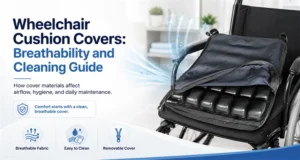
In hospitals, cushions continue to function as noncritical patient-care surfaces and must withstand routine disinfection with EPA-registered hospital disinfectants per CDC guidance and facility policy. Surfaces must also be compatible with the contact times and chemistries used on nonporous equipment.
Fire safety
Materials must show resistance to ignition. This is covered by ISO 16840-10 for wheelchair seating, and, in the U.S., is routinely supplemented by state or facility guidelines, including California TB117-2013, which addresses upholstered materials.
Common Cushion Types Used in U.S. Hospitals
Hospitals typically standardize across several cushion categories to match patient risk levels and care areas:
| Cushion type | Key features | Advantages | Typical hospital use cases |
|---|---|---|---|
| Foam cushion | Single- or multi-layer viscoelastic/HR foam; sometimes with contoured base | Light weight, cost-efficient, predictable support | ED and short-stay units; low-risk or short-term users |
| Gel cushion | Gel insert(s) under fluid-impermeable cover; may be gel-foam composite | Thermal moderation, stability, good pressure dispersion | Post-op recovery, med-surg units; patients with moderate risk of pressure injury |
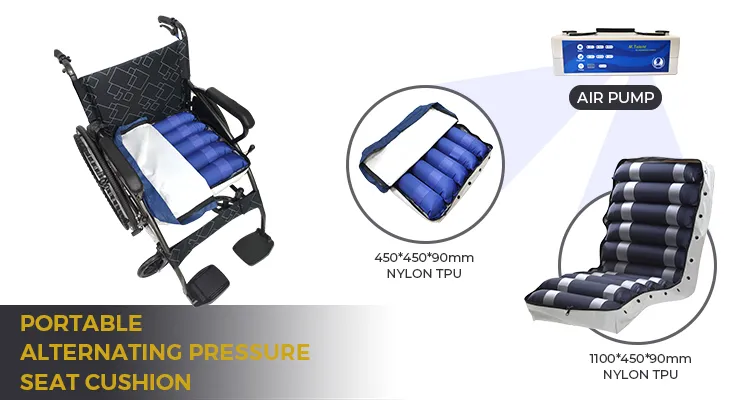
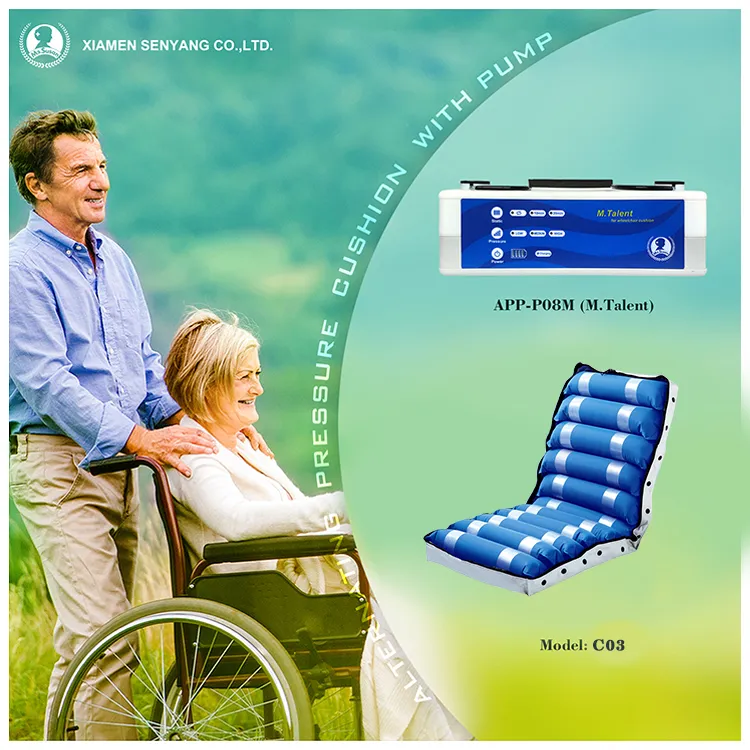
| Air cushion | Adjustable air cells or bladders; single- or multi-chamber | High pressure redistribution; tunable immersion/envelopment | High-risk pressure injury prevention, ICU and complex rehab consults |
| Hybrid cushion | Foam + air (and/or gel) in layered or zoned configuration | Blends stability and skin protection; often lighter than full air | Inpatient rehab units; long-term sitting; mixed risk profiles |
While naming conventions vary by brand, the functional distinctions above mirror how clinical teams match a pressure relief cushion for hospitals to patient risk and mobility needs.
U.S. Regulatory and Hospital-Grade Requirements
FDA device classification and market entry
-
Product codes and regulations. Wheelchair cushions are regulated as flotation cushions (§890.3175) and as wheelchair components (§890.3920). Both are considered medical devices that serve medical purposes (e.g., mitigate pressure ulcer formation, and/or are components of a wheelchair system).
-
Device class and 510(k). Most cushions are Class I devices that are generally exempt from 510(k) premarket notification requirements, and still has to comply with some General Controls. These include device registration and listing (21 CFR Part 807), quality system regulation (21 CFR Part 820), labeling, and MDR reporting.
-
Registration and listing. as a condition of ensuring that an FDA approved (more accurately, an FDA-regulated and legally marketed) wheelchair cushion is available for marketing in the U.S., the manufacturer must register their establishment and list their devices.
Biocompatibility for skin-contacting devices
Since the covers of cushions and in some instances, internal components, are in contact with intact skin for prolonged terms, hospitals and manufacturers expect compliance with the ISO 10993 risk-based evaluation and FDA 2023 biocompatibility guidance (e.g. contact- irritants, and sensitizers for surface devices in contact with skin).
Performance, ignition resistance, and durability
-
Tissue integrity performance.
ISO 16840-2 specifies the apparatus, test methods, and disclosure requirements for the evaluation of wheelchair seat cushions intended to maintain tissue integrity and prevent tissue trauma. This standard outlines evaluation methods for assessing the pressure redistribution characteristics of various cushions. An amendment to this standard will be published in 2024. This will address additional and updated elements of the standard.
-
Ignition resistance.
ISO 16840-10, recognized by the FDA, incorporates ignition resistance elements for wheelchair seat cushions and other components, which includes the seat's protective covers and cushions. This standard relates to the risk of cushion ignition during hospital fire safety procedures.
-
State flammability regulations.
In California, some facilities use TB117-2013, which incorporates smolder resistance requirements for cover fabrics and certain fillings, as a standard for upholstered materials.
Infection prevention and cleanability
-
CDC/EPA alignment.
Cushions used on non-critical environmental surfaces should be compatible with EPA-registered hospital disinfectants and with CDC recommendations for environmental services. Procurement teams often check that cover materials are fluid-resistant, nonporous, and maintain integrity after repeated wipe-downs at the required contact time.
-
Processing guidance.
Where cushions are reusable and may require high-level cleaning or reprocessing steps (e.g., removable covers), manufacturers typically supply validated instructions following AAMI TIR12 principles for devices intended to be processed by healthcare facilities.
Coding, coverage, and purchasing
-
HCPCS / Medicare.
Hospitals and discharge planners often reference HCPCS E2601–E2625 for general use and skin-protection/positioning cushions. Local Coverage Determination (LCD L33312) and relevant policy articles outline coverage criteria and the distinction between general use versus skin protection cushions, including PDAC verification for some adjustable models.
What Hospital Buyers Typically Evaluate
-
Regulatory conformity. Although hospital buyers might be unaware, the specific evidence they look for is documentation of FDA registration and listing for the cushion and manufacturing site, determination if the medical grade wheelchair cushion is Class I 510(k)-exempt, and compliance with 21 CFR Part 820 (Quality System Regulation).
-
Quality management certification. Having third-party certification to ISO 13485, wherein the hospital describes and explains process control, traceability, and post-marketing surveillance, is frequently requested in hospital tenders and GPO contracts. This may be the only non-clinical evidence of quality management hospital buyers might be exposed to.
-
Clinical performance and safety data. Hospital buyers might weigh evidence of ISO 16840-2 for pressure redistribution, ISO 16840-10 for ignition resistance, and ISO 10993 for biocompatibility with FDA-aligned assessments as clinico-legal evidence.
-
Infection control compatibility. Design and seam construction to appropriate withstands EPA-registered hospital disinfectants, and well articulated IFUs for cleaning and reprocessing offers evidence of infection control.
-
Durability and service life. Cover abrasion resistance, hydrolysis resistance, and maintenance features (e.g., replaceable covers, repair kits) are factors in determining total cost of ownership and stock rotation policies, which are often neglected in the justification of sale.
How Senyang’s Hospital-Grade Solutions Align
Senyang specializes in designing wheelchair cushions for hospitals with a standards-first approach for the acute and post-acute care environments:
Regulatory status and QMS. Senyang’s cushions are produced within the framework of an ISO 13485 quality management system. This includes design controls, supplier oversight, process validation, and complaint management systems expected by U.S. hospitals and regulators. For Class I devices, we maintain establishment registration and device listing under 21 CFR Part 807.
By aligning design, materials, and documentation to these norms, Senyang supports hospital procurement teams in meeting clinical, safety, and compliance objectives without resorting to promotional claims.
Conclusion
Evaluation of wheelchair cushions in U.S. hospitals is dominated by three primary factors: compliance, safety, and clinical effectiveness. Compliance means checking for FDA registration and listing, ISO 13485 quality system standards, and documentation for ISO 10993, ISO 16840-2, and ISO 16840-10. Safety and operational standards require cushions to resist ignition and endure repeated disinfection with EPA-registered hospital disinfectants per CDC guidelines. Clinically, cushions must deliver the right degrees of immersion, envelopment, and stability to protect tissue integrity across the spectrum of care from the ED, to the ICU, and into inpatient rehabilitation. Guided by these principles, Senyang can design hospital wheelchair cushions tailored to the needs and regulatory context of U.S. healthcare providers.
FAQ
Q1: Are all wheelchair cushions in U.S. hospitals FDA approved?
The FDA “approves” only certain high-risk devices; most wheelchair cushions are class one and are exempt from 510(k) registration. They must meet FDA General Controls, including establishment registration, device listing, labeling, and quality system requirements. Hospitals should check listing status and compliance documents.
Q2: What’s the difference between hospital-grade and home-use cushions?
Even though it is not a legal classification, “hospital-grade” in practice means the cushions are designed for a clinical environment, which includes being documented for use with EPA-registered hospital disinfectants, being able to withstand ignition, and the rigor of the quality system (e.g., ISO 13485). Models for home use may not meet as many of the institution-specific requirements.
Q3: How often should hospital wheelchair cushions be replaced?
There are a number of factors which determine the replacement interval, which include cover integrity, the condition of the foam/air system, system cleaning frequency, and manufacturer IFUs. Facilities tend to focus on inspection criteria (support loss, cover damage, seam failure) instead of a set time for exchange, which is aligned with the QMS and maintenance policies.
Q4: Does Medicare cover hospital wheelchair cushions?
Yes—under HCPCS E2601–E2625, Medicare will reimburse for wheelchair cushions as long as the medical necessity criteria are met. Medicare policies classify cushions as general-use or skin-protection/positioning cushions and may require PDAC verification for certain adjustable models.
Q5: What certifications should hospitals look for when choosing a cushion supplier?
Popular requests often include ISO 13485 certification, biocompatibility evidence according to ISO 10993 with FDA correspondence, ignition-resistance and performance according to ISO 16840-2 and ISO 16840-10, documentation of compliance with EPA-registered hospital disinfectants, and CDC environmental services standards.